I Resist
Against Dichotomies

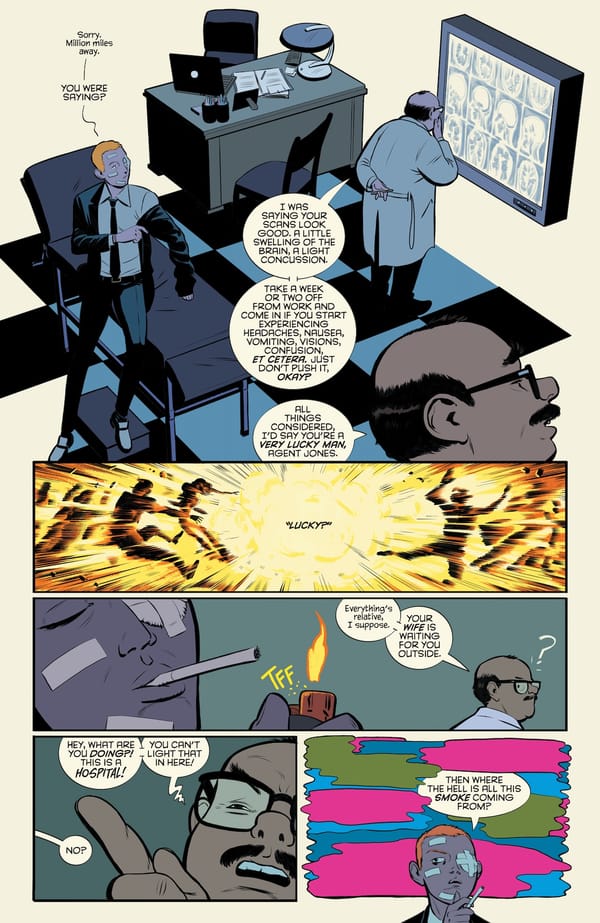
I resist the separation. I resist the separation of “happy” and “sad”. The idea that there need to be both in a space, that there must be some “balance” between what we’ve been taught to call happiness and sadness. The separation is deceptive; it betrays the kinship and connectedness that all experiences and sensations must have. We do not need to cleanse our palates of tragedy by speaking of “happy” things. This is not a treatise against joy, but rather a rejection of the dichotomy that seeks to place our experiences in little boxes that open us up to placation via capitalism. It is profitable to shove our experiences into little boxes, because how could a product really bridge more than one emotion at a time. A Marvel movie has never been complex because complexity is hard to sell. An advertisement that’s complex doesn’t leave you reaching for your wallet, it leaves you scratching your head or breathing more deeply than you were 30 seconds before. That doesn’t make anyone money.
To ground this in personal experience, an appeal that often does make people money, the most fulfilling things in my life are those of complexity. Whether it be friendships, works of art, or simply sections of time, the complexity is what makes me a more whole human, what makes my memories stick, and what makes it all worth it. I don’t find myself enriched by a one-note experience. A flavor that has no depth is not memorable, nor is it really interesting. A Rothko is resonant because of its texture, not because of its perceived homogeneity.
The less you eat, drink and buy books; the less you go to the theatre, the dance hall, the public house; the less you think, love, theorise, sing, paint, fence, etc., the more you save – the greater becomes your treasure which neither moths nor rust will devour – your capital. The less you are, the less you express your own life, the more you have, i.e., the greater is your alienated life, the greater is the store of your estranged being. - Karl Marx, Human Requirements and Division of Labour Under the Rule of Private Property
The greatest joys are those grounded in the understanding of the sorrow. The interweavings of grief and love are not easily explained (see: thousands of years of art), but neither of them can grow into much of anything without the other. As 50 Cent says, “Joy wouldn’t feel so good if it wasn’t for pain”. My love has learned so much from my grief, and my grief cannot exist without my love. The moments where I try to turn away from either are the weakest moments of my life. This is not to say that every moment must contain some mythical balance of the two, both because the lines can never be clear between them (to describe them with two wholly separate words is already deeply reductive) and because they must move in and out like the tide. The waves must ebb and flow as the sand shifts and the moon moves. Some days you will nearly drown in it, and other days you will forget that your toes are wet.
I spent a few hours at a friend’s house last night. I didn’t feel entirely present, and I’m still thinking about that 26 hours later. Part of me feels bad that I wasn’t, but a more reasoned part of me has figured out that I needed something different than what I got in that space. This is not to speak ill of the lovely people I was with, but to speak to the balances that a life must house. I found myself slipping into the tide of grief many times throughout that night, and I could tell that I needed something else. I was fortunate enough to find that today. I am forever grateful that I have space in my life for all of this. It is each of these pieces that make all of the others possible, and to try to separate all of these moments from each other does a disservice to a responsible understanding of a life. Nothing can exist without its consummate parts, and my life is made of all of these parts. I cannot do the work without the rest, I cannot laugh without being heard, and I cannot breathe without air.
Thank you to the hands that carry me to the places I need to be, thank you to the hearts that beat next to mine, and thank you to the mouths that smile when our eyes meet.
I love to credit Walt Whitman’s poetry with unlocking a new understanding of the connectedness of the world for me, but it is a disservice to the professor who framed it as such and the infinite other works that instantly harmonized with Whitman when I encountered him to pin it all on a single poet.
Almost everything I think about now is connected to everything. Sometimes this becomes too much, but I don’t think there’s anything to do about that except to plant my feet back on the ground in some kind of action. Academia (I can speak mostly to the humanities) loves to encourage deep thinking about everything but to loudly discourage any true engagement with that which we discuss. I think a lot of people get truly stunted by this. It is hard to find the will and ability to actualize the intellectualizations that you write and talk about for class after class, but that actualization is the only possible way to stay in touch with your humanity. Intellectualization without a grounded practice is where truly harmful pretention is born.
I’ve been thinking a lot about how best to approach the past. My professors would be proud of me, as this is exactly what many of my classes have been talking about lately. As a historian, I see the efficacy and importance of understanding the past as alien to us; as a totally different world with its own languages and currents. As an artist, I would rather see nothing above the human, to simply feel the kinship of emotion across every epoch. As a revolutionary, I would love for it to all be teleologically continuous, progressing consistently and always towards some higher ideal of social organization. Despite my revolutionary and artistic tendencies, I think it is unfair to our ancestors to only understand them in our own shadow. The past must be alien in order for it to truly be in conversation with the present and the future. Just as true love must be predicated on an understanding of the humanity of those you love, a humanity that must be distinct from your own. This sometimes feels contradictory, but these chosen separations - those that we must create in order to comprehend the world around us - are distinct from the imposed separations of close-minded and reactionary currents. In order to fully exist in oneness, I must first come to an understanding of my place within it.
I write this while staring at my journal and reading the question, “is a methodology an end in itself?” I think this is an important question, especially for my classes focused on historiography. I think it speaks to the deconstruction of outcome-based thinking that we must reach to get anywhere outside of capitalist systems. It speaks to a deconstruction of binaries, of generalizations, and of orthodoxies. It also borders on incomprehensibility. It’s a question that rests on prerequisities and certain intellectual proclivities. I do think it is a mistake to cast all “intellectualism” as pretentious, largely because that paradigm rests on an assumption that the “masses” are incapable of engagement with abstractions, itself a deeply pretentious premise, but there are certainly limits on who language can reach. I think I will spend the rest of my life trying to ground my own intellectualizations in language that can be shared, and I do not think any answer can ever be reached. Sometimes I reach for movies, sometimes I reach for poetry, sometimes I reach for music. All of these are of one tradition, all of us are of one current, flowing forwards and backwards through the future and the past. Nothing can be set apart, whether it is your own mind or the language you use to understand it. Don’t try to chase away the sad shit with something happy; learn how to breathe in both joy and grief.