Can You Hear the Music?
Some thoughts on Oppenheimer!

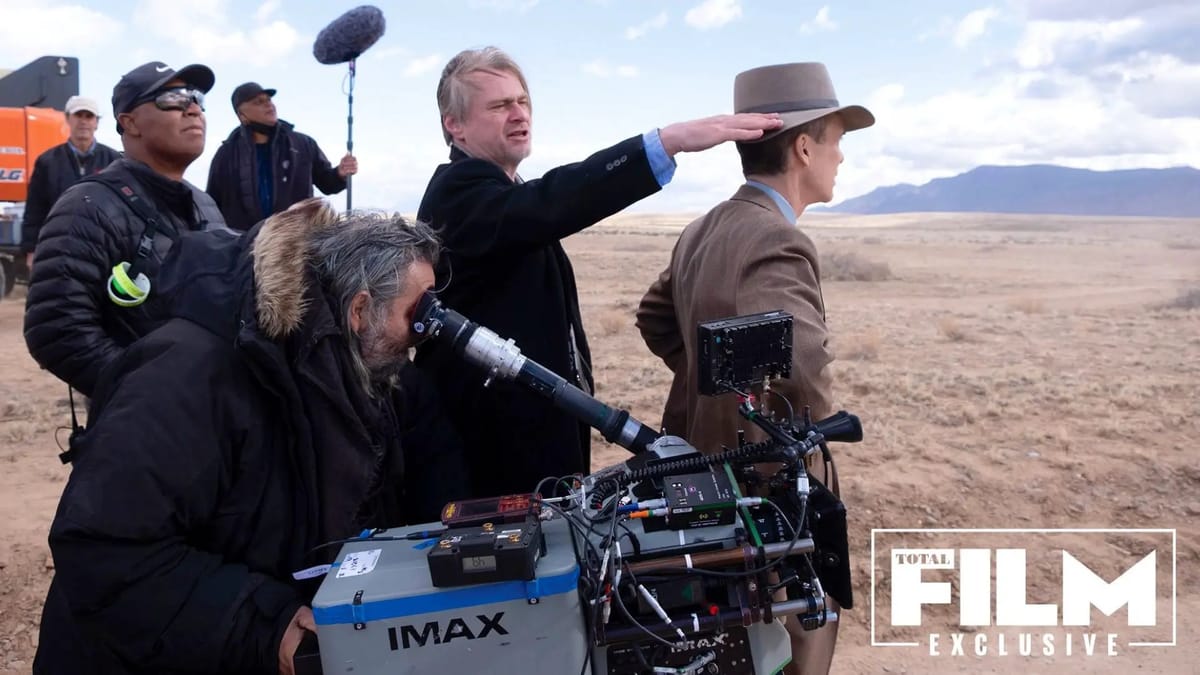
Oppenheimer is a triumph. I consistently found myself near-baffled at how all of its consummate parts wove so harmoniously. Few films I’ve seen are as well-edited, well-shot, well-performed, and effective. I had taken in effusive praise for Oppenheimer in the week after its release, as this pleasantly surprising cultural moment of “Barbenheimer” has led to an atmosphere of love for movies I don’t think I’ve seen on this scale in my memory, but I was still a little doubtful that it would be as revelatory as described. I haven’t historically been a big Nolan fan, which is beginning to sound silly as both Tenet and this are already all-time favorites of mine. Despite my love of his recent output, I am not a big fan of the Dark Knight Trilogy, something which tempered my enthusiasm for this given the necessarily knotty politics involved. Somehow, Christopher Nolan made a transcendent work of frequently near-impressionist film with as good politics as a movie about J. Robert Oppenheimer appears to be capable of.
The intricate successes of Oppenheimer may be explicated by me elsewhere, as I remain stunned by the density and effectiveness of its storytelling and thematic construction. In the past, Nolan frequently struggled with balancing his confidence in his own storytelling and the audiences’ capability for understanding and retaining themes and ideas, often spending far more time than necessary or engaging on exposition or simply explaining themes instead of embedding them through visual and/or sonic motifs. Where Nolan’s earlier scripts often remained in love affairs with didacticism and never broke free of traditional rhythms - keeping action and dialogue in their own siloed off sections of the movie - Tenet flirted with disruptions to this structure, eschewing the over-reliance on exposition; and Oppenheimer now almost entirely blows up these past crutches. His recent films still retain scant flashes of the didacticism which hurt his previous films, but his confidence and the deft weaving of themes and motifs throughout, along with the fantastic editing of Jennifer Lame has unlocked new heights for Nolan’s films.
One of the many great joys of film-making as an art form is its collaborative nature. While auteur theory frequently has many merits, as examining the bodies of work of the editors or cinematographers of great movies is often comically illuminating as to the importance of a director, it is undoubtedly only through the collaboration between those crew members and the directors that these movies reach their heights. None of Christopher Nolan’s movies before Jennifer Lame began editing his have such engaging and effective rhythms, though Lame’s films without Nolan (notably Hereditary) have nothing close to that rhythm. Hoyte van Hoytema (Nolan’s DOP since Interstellar) has a far more consistently great filmography, but his movies with anyone not named Christopher Nolan or Jordan Peele do not have what those ones do! Every great film is a convergence of hundreds of artists finding new heights together.
One of the most powerful takeaways I walked out of the theater with was one of artistic inspiration. If an artist whose output I have at times actively disliked can grow to a point where I find a film of his genuinely transcendent, who’s to say anyone can’t grow and learn to a similar point. This is the joy of any chronological exploration of an artist’s oeuvre, but most of these explorations consist of witnessing their refining of something you already love, or seeing their approach to something you dislike simply change shape. It’s a great pleasure to watch an artist grow out of dislike to create works that you love, and that pleasure echoes into both artistic and interpersonal living, providing fresh and powerful inspiration that I hope to hold onto for a while. The privilege to live and grow as a person and artist is the joy of the human condition, and every tragedy stems from the denial of that. While Oppenheimer as a work within an artist’s body of work inspires, one of the tragedies of the story within the film is Oppenheimer’s terminal inability to learn and grow as a person. He consistently backs down from the challenges of living, choosing to dodge responsibility and deny his own culpability in the tragedies of every scale within his life. A breathtaking film.