all these old bones
I am interested in building a way to live.

How do we imagine a future? A friend of mine more or less posed this question to a group chat over the weekend. They were specifically interested in how we can build a world where the absolute worst of the worst can continue to exist. It does not feel possible to imagine a world of coexistence with monsters who are purposefully murdering children, but a healthy radical future must consider that reality. We talked for a while about how indulging in punitive and carceral paradigms of retribution and an eye for an eye will simply reproduce the dynamics that got us here. We talked about how impossible it is to imagine anything but retribution from our present position. We did not come to any concrete answers, because those don’t exist. We did conclude that these radical imaginations that we must build must be collective. No single person can imagine the future. It is a work of many minds and many souls to imagine an entire world that improves on and supplants the one we currently occupy. It is a work of many more to build that future.
Spoilers for the Castlevania anime and Andor to follow, specifically early set-up and some denouement in Castlevania and a major midseason arc in Andor! I hope my writing inspires interest in both because I really don’t get into a lot of the minutaie of either show.
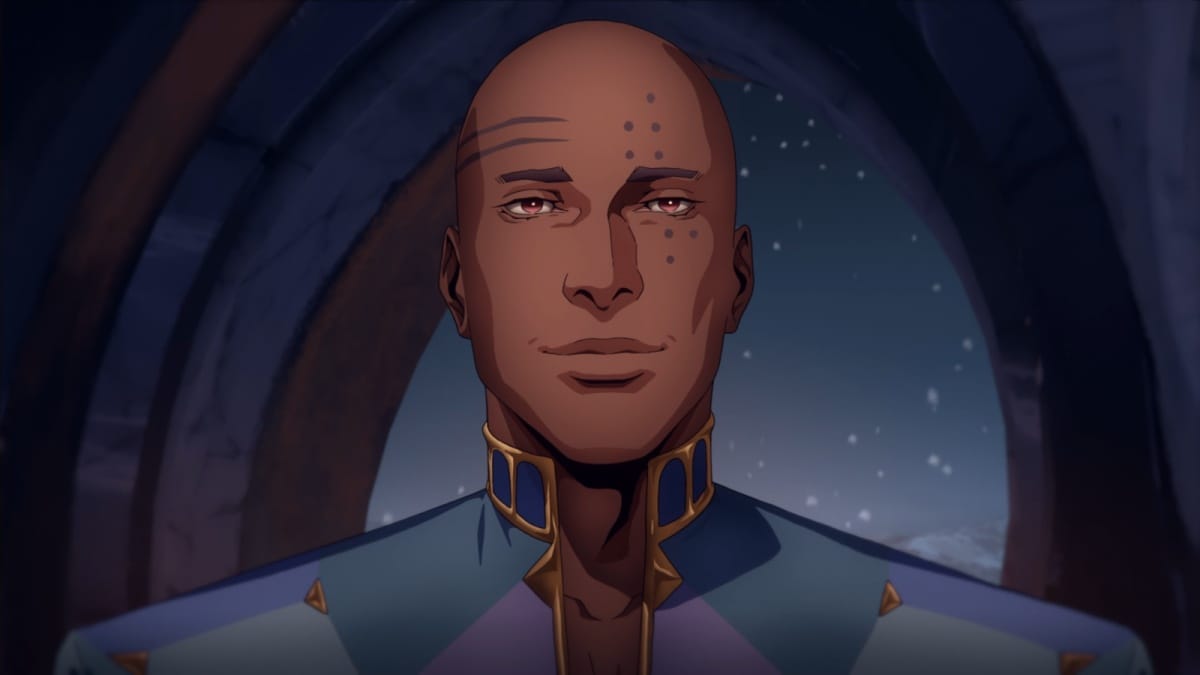
In Castlevania Season 4, Episode 6, the character Isaac performs one of the most stunningly resonant monologues I have ever encountered in fiction. In the aftermath of the battles and conflicts of the series, Isaac is asked what he wants, “I have recently begun to consider the future... which has been a novelty for me, because I never really thought I had one.” The conversation I had with my friends about imagining futures pushed my brain to return to this monologue. It is radical to imagine a future. “This is how they get us, Hector. They convince us that there is no future. There's only an eternal now... and the best we can do is survive until dawn and then do it all again.” The mere act of considering a future for ourselves is radical, as so much of the work of the systems arrayed against us is discouraging that imagination and that reality.
It is a work of many minds and many souls to imagine an entire world that improves on and supplants the one we currently occupy. It is a work of many more to build that future.
I’ve been watching Andor lately. Operating almost exactly like real prisons, the Narkina 5 prison in Andor serves as a demonstration of how futures can be denied. The prisoners do not get to see sunlight, and they all cling desperately to their slowly decreasing sentences, constantly displayed in their sleeping quarters. It is only once they are forced to realize that they have no future that they rise up and break out. A prisoner is transferred from one section of the prison to another when it is time for their “release”, and when this gets out, the prison administrators electrocute over a hundred prisoners to try to keep it quiet. They fail, and it is the knowledge of the hopelessness of their situation that inspires the remaining prisoners to fight their way out. Once they realize that they are going to die in this prison if they do not do something, they begin to truly fight.
“I'd rather die trying to take them down than die giving them what they want.” - Cassian Andor, Episode 10 of Andor
Isaac’s monologue also considers one of the reasons why the monsters who run our world abhor the future with such vitriol. When speaking of Dracula, the vampire king who somewhat set the disasters of the series in motion, Isaac says, “He lived in one long night, and never the future.” Dracula had plenty of reason to hate humanity and not believe in a future; his wife’s murder by human priests destroyed the only real love he had ever known. It is within this contradiction, that of Dracula’s monstrosity and evil coupled with his genuine hurt and pain, that I can start to imagine a future for the monsters of our real world. Every person who chooses to hurt others has their reasons, whether as straightforward as Dracula’s grief or as complex as the pressures of the systems we live within, and it is only once we can truly comprehend this that we can begin to see these depraved lunatics as human. It is hard to truly believe that they deserve to be called human, but it is only in doing so that we can truly claim to believe in building a loving reality.
While Andor is a shockingly fantastic show, especially for something created in the beating heart of the entertainment empire, it fails to imagine a revolution built on love. This is not to say that it inadequately or incorrectly portrays the fight, but it is frequently not very optimistic about the realities of the fight. Many characters are isolated by the Empire, whether monetarily, materially (by arrest or incarceration or simple physical location), emotionally (due to the necessity of anonymity in criminal actions), and many other ways. It is heartbreaking to see the Empire of Andor meticulously pick apart the resistance, but it is powerful to think forward to the context of the movies that Andor precedes and see the rebellion that sprouts from the heartbreak of Andor. Luthen, Stellan Skarsgård’s Lenin stand-in, delivers a speech in the 10th episode that drove home some of the brutal possibilities of revolution that the show is constantly in conversation with. When asked by a spy what he sacrifices, Luthen launches into a heartbreaking monologue, “I'm condemned to use the tools of my enemy to defeat them. I burn my decency for someone else's future. I burn my life to make a sunrise that I know I'll never see.” The choice – one that many revolutionaries in history have made – to play the game on the enemy’s terms, is one that we can wish to never have to make. I do think that Luthen’s willingness to throw himself into the mouth of the beast is some of what sets up the Rebellion to reproduce the dynamics that sink it post-revolution, and there is possibly a world in which more thoughtful and deeply radical rebels could have built a healthier world. Unfortunately, much like real empires, the Galactic Empire does not allow much room beyond its own terms. The absolutely unshakeable discipline and commitment that are required to accomplish anything while operating within new paradigms of radicalism are almost impossible to maintain under constant assault. There is far more to be learned about these challenges from the writings of real revolutionaries than the Star Wars movies, but if Star Wars can springboard us towards revolutionary consciousness, I will certainly take advantage of it.
Isaac’s final few sentences are ones that I will carry with me forever. “I will instead build something new on all these old bones. Something where people can live for a future. I'm going to live.” These three sentences contain within them almost every piece of the philosophy I wish to carry. The necessity of building on and from “old bones” is key to these imaginations and new realities. We cannot disregard the work that has come before us, the bones of our ancestors and our martyrs in this struggle. We cannot build something new without reducing the old to bones; nothing can grow where something has not died. The importance of building a world for life, not a world to defend against death, is almost impossible to overstate. It is not something that we are allowed to think much about, as the world that we fight against is one defined entirely by death. We are rarely allowed to imagine something beyond death itself, much less a world where we can, as Isaac says, live.